Caribbean Passport and Schengen: EU Deadline 12 November
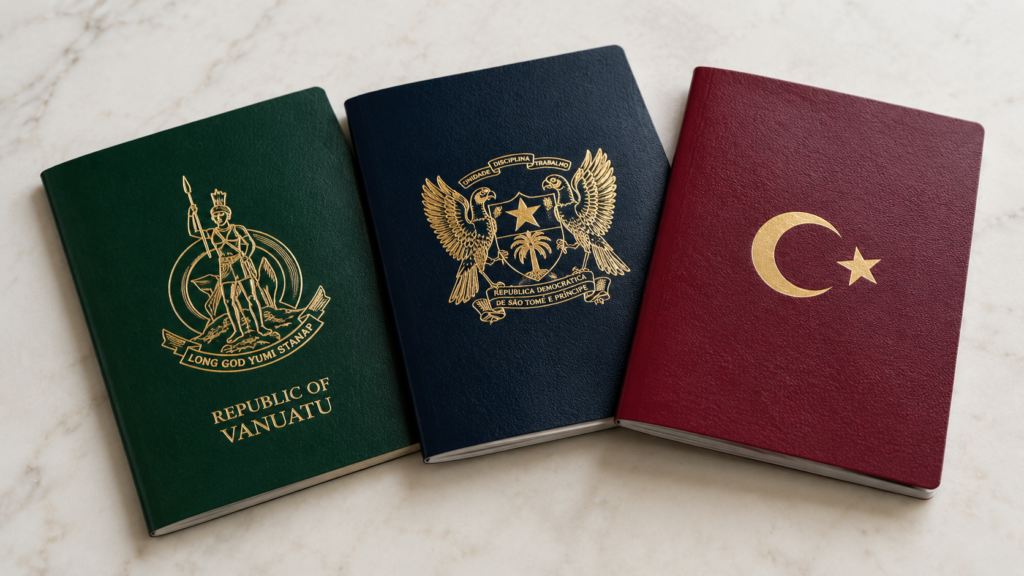
A Caribbean passport may lose visa-free access to Schengen sooner than the market expected. The European Commission is waiting for a response from five island states by 12 November 2026: either keep citizenship-by-investment programmes and accept the risk of losing visa-free entry to the EU, or confirm the closure of the programmes by June 2028. The precedent has already been set with Vanuatu, and the figures look surprising.
Caribbean Passport and Visa-Free Schengen: What Brussels Demands
On 25 June 2026, the EU Commissioner for Home Affairs, Magnus Brunner, sent a letter to Antigua and Barbuda demanding the wind-down of its citizenship-by-investment programme by 1 June 2028, with a 24-month transition window. According to the government of Antigua, similar letters were received by four other states with passport schemes: Dominica, Grenada, Saint Kitts and Nevis, and Saint Lucia.
The legal basis for the demand is Regulation (EU) 2025/2441, an updated mechanism for suspending the visa-free regime. It entered into force on 30 December 2025, and under it, the very existence of an investment citizenship programme has become a sufficient ground for suspending visa-free travel. The full text is published in the Official Journal of the EU: https://eur-lex.europa.eu/eli/reg/2025/2441
On 12 November 2026, governments must inform the European Commission which path they choose: continue the programmes and accept the risk of losing visa-free access, or confirm closure by June 2028. The Prime Minister of Antigua and Barbuda, Gaston Browne, said on 24 October 2026 that the cabinet is preliminarily inclined to confirm the wind-down. There is no final decision yet, and a meeting of the five countries to agree a common response is still to come.
Two details for calculations. Confirmation will not stop the acceptance of applications immediately: the programmes will continue to operate until June 2028 under the transition conditions to be determined by Brussels. At the same time, 12 November is the deadline for adopting commitments, as voiced by the Prime Minister of Antigua: the text of the European Commission’s ultimatum has not been officially published.
Two Scenarios for Caribbean Passport Holders
Scenario one. The islands close their citizenship-by-investment programmes, and the visa-free regime with Schengen is preserved. Holders of already issued passports continue to travel to Europe without visas, and the market receives no new passports.
Scenario two. The countries keep the programmes and lose visa-free access. In this case, the restrictions affect all citizens: both local residents and investors who paid hundreds of thousands of dollars for a passport. For a passport holder, this option is worse, since it directly changes the usual travel arrangements.
Scenario two cannot be ruled out for budgetary reasons. According to Gaston Browne, over eleven years the Antigua programme brought in more than 1.4 billion Eastern Caribbean dollars, about $518 million. The 2026 budget includes 157 million Eastern Caribbean dollars, about $58 million, in programme revenues — one of the largest non-tax sources of income.
In parallel, the islands are tightening their own rules. On 14 July 2026, Gaston Browne introduced a bill in parliament amending the Citizenship by Investment Act 2013: mandatory presence of 30 days within five years after obtaining citizenship, plus independent audits of the relevant unit. There is no data on the adoption of the bill in open sources.
The Vanuatu Precedent: Visa-Free Access Removed, Revenues Grew
Vanuatu is the only worked-through case that shows market behaviour after losing visa-free access. The United Kingdom introduced a visa requirement for Vanuatu citizens in July 2023, and Brussels removed visa-free access to Schengen in December 2024.
According to the average annual report of the Ministry of Finance and Economic Management of Vanuatu dated 25 July 2026, in the first half of 2026 passport schemes brought in 11.4 billion vatu, about $95.5 million. This is approximately 39% of the 29 billion vatu collected excluding donor financing.
30.4% for the same period of 2025, about 39% for the first half of 2026. A caveat on data quality: an industry publication that analysed the report noted internal inconsistencies in the published figures.
Conclusion for risk assessment. The loss of visa-free access with Schengen and the United Kingdom did not stop demand for the passport: the programme continued to grow. The economic motivation of the islands to keep the schemes remains strong, and scenario two is therefore realistic.
Visa-Free Passport and Residency: The Difference in Rights
A visa-free passport gives the right of short entry as a tourist. A residence permit gives resident status: a legal basis to live in an EU country, access to banking, healthcare, and education as a resident.
The difference shows at the moment when a political decision changes the visa regime. Visa-free travel is the subject of agreements between Brussels and a third country. A national residence permit is issued by a specific member state under its own legislation.
Parameter: Status on entry — a visa-free passport gives tourist status, an EU residence permit gives resident status.
Length of stay — a visa-free passport gives short visits within the limit, a residence permit gives residence on the basis of status.
What it depends on — a visa-free passport depends on the decision of EU institutions regarding a third country, a residence permit depends on the legislation of a specific EU country.
Access to banks and services — with a visa-free passport as a non-resident, with a residence permit as a resident.
Revocation for foreign policy reasons — possible for a visa-free passport, while the visa suspension mechanism does not apply to a residence permit.
Greece Residency for €250,000: How It Works with a Second Passport
The Greek residence-by-investment programme in real estate operates in Athens with a threshold from €250,000. An alternative for those who need a suburban format and larger area is villas from €800,000.
The logic of the combination is simple. A neutral second passport already in hand closes the question of filing. Greek residency closes the question of rights: the ability to live in Europe and move around Schengen ceases to depend on Brussels’ negotiations with the islands.
According to Nevestate’s practice, for Russian citizens, entry into the Greek programme is built through a second passport. Those who already have a Caribbean passport have completed half the journey: all that remains is to select a property in Athens and file the application. For others, the working combination is first a Vanuatu passport, then filing for Greek residency.
Law enforcement under the Greek programme is tightening, and this should be taken into account when preparing the deal. In October 2026, the Greek Minister of Migration and Asylum publicly identified two practices that lead to the annulment of investor status: hidden refunds of part of the price and short-term rental of the property through parallel subleases bypassing the prohibition.
What a Caribbean Passport Holder Should Do: A Practical Plan
- Check the documents: passport validity, date of issue, completeness. Under scenario one, an already issued passport retains visa-free access.
- Keep three dates in your calculations: 12 November 2026 — the governments’ response, December 2026 — the European Commission’s report, 1 June 2028 — the deadline for winding down the programmes.
- Separate the tasks. The passport addresses citizenship and filing; residency addresses rights in Europe.
- Back up the passport with EU residency: selection of a property in Athens from €250,000 and filing for Greek residency.
- Calculate the full cost of entry: taxes on purchase, notary and legal expenses, fees for the application and renewal of status.
- Prepare documents in advance: proof of source of funds and transfers take weeks.
What to Watch and Where to Write
Separately, it is worth watching the breakdown of the Greek programme with Athens properties. We covered this in a video: conditions for obtaining residency and the Athens market, the application procedure, property types, taxes and expenses on purchase — https://www.youtube.com/watch?v=GqZc9HeOqyg
If you would like to work through the combination of «second passport plus Greek residency» for your situation, write to us on Telegram: @Nevestate_admin. We will select properties in Athens from €250,000 and outline the filing procedure step by step.
And what matters more to you in a second passport: visa-free entry to Schengen or other opportunities? Write in the comments which scenario you consider more likely.